Press Play on Japan: How Anime Composers Are Quietly Taking Over Your Spotify Queue
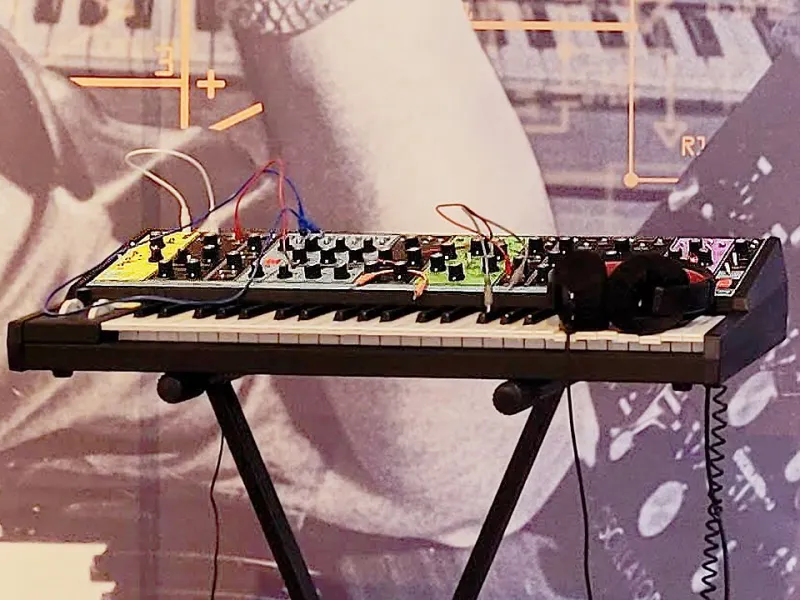
Photo: Moog Claravox Centennial Theremin (left), Moog Matriarch (center), and Moog modular synthesizer (right), with wall art of Robert Moog - Moog Music Factory, Asheville, NC (2021-08-04 11.08.58 by Charity Davenport @Flickr 51644541617).jpg: (Flickr: M
There's a good chance someone in your social circle has a playlist titled something like "late night study vibes" or "main character energy" — and if you scroll through it, you'll find something interesting buried between indie pop and lo-fi beats: anime soundtracks. Not J-pop. Not even opening or ending themes. Full-on orchestral scores from shows like Violet Evergarden, Sword Art Online, and Frieren: Beyond Journey's End.
This isn't a niche trend anymore. It's a full-blown cultural moment — and it's quietly rewriting the rules of what American audiences reach for when they need music that actually feels like something.
The Numbers Don't Lie
Spotify's internal data, shared through its Loud & Clear transparency reports, has consistently flagged anime-adjacent music as one of the fastest-growing discovery categories among listeners aged 16 to 24 in the US. Tracks from Yuki Kajiura's Sword Art Online catalog have individually surpassed 50 million streams on the platform. Evan Call's score for Violet Evergarden has become a go-to recommendation in classical and cinematic music circles — not just anime ones.
YouTube tells an even wilder story. Full OST uploads for mid-tier anime series routinely pull in tens of millions of views, often from listeners who found the music through algorithm recommendations rather than the show itself. That's a critical distinction. The music is traveling ahead of the IP, functioning as its own cultural product.
Apple Music has quietly leaned into this. Their "Anime Essentials" playlist — once a curiosity — has grown into one of the platform's more engaged genre playlists in the US market, sitting comfortably alongside editorial picks for film scores and ambient music.
The Composers Driving the Wave
If you want to understand why anime soundtracks hit differently, you have to understand the people making them.
Yuki Kajiura is probably the closest thing the anime music world has to a household name outside Japan. Her work spans Puella Magi Madoka Magica, the Fate series, and Sword Art Online, and her signature sound — layered choral vocals, minor-key strings, and an almost operatic sense of scale — has influenced a generation of Western listeners who couldn't necessarily name her but would recognize her music instantly. She's the composer who taught a lot of American anime fans that a soundtrack could be as emotionally complex as the story it underscores.
Evan Call, an American-born composer based in Japan, occupies a fascinating middle space. His work on Violet Evergarden and Frieren feels fluent in both Hollywood cinematic tradition and Japanese emotional storytelling — which might explain why his music crosses over so effectively. American listeners hear something familiar in the construction, but the emotional register is distinctly shaped by the anime context it was built for.
Then there's Hiroyuki Sawano, whose bombastic, hybrid orchestral-electronic style on shows like Attack on Titan and Mobile Suit Gundam: The Witch from Mercury has made him a darling of the "epic music" community on YouTube — a space where millions of American listeners go specifically to find music for workouts, gaming sessions, and creative projects.
Why This Music Works for American Ears
Music curators who work in the streaming space have started paying serious attention to this shift. The consensus is that anime OSTs fill a gap that Western film and TV scores often don't.
Hollywood scores have trended toward a particular kind of emotional restraint over the last decade — lots of ambient texture, minimal melodic hooks, music that supports without leading. Anime composers, by contrast, aren't afraid to go big. There are actual melodies. There's dynamic range. The music is designed to make you feel something specific, not just set a mood.
For Gen Z listeners who grew up with the emotional directness of K-pop and the maximalism of hyperpop, anime soundtracks feel intuitive. They're not subtle. They're not background noise. They demand to be listened to — and that's exactly what a generation of playlist builders is looking for.
The Gateway Drug Effect
Here's where it gets culturally interesting. Anime OSTs are functioning as a gateway into broader Japanese music culture in a way that even J-pop hasn't fully managed.
Listeners who start with Kajiura's orchestral work often find themselves exploring traditional Japanese instrumentation — koto, shakuhachi, taiko — because those elements appear in the scores they already love. Evan Call's work on Frieren has sent people down rabbit holes into Nordic folk music and Japanese acoustic traditions simultaneously, because his compositions blend both.
Streaming algorithms are picking up on this behavior and building recommendation chains that would have seemed improbable five years ago: a listener starts with a Demon Slayer OST, gets served a Yuki Kajiura deep cut, lands on a traditional Japanese music playlist, and ends up subscribing to a Tokyo-based independent record label. That's a cultural pipeline that no marketing team planned — it just happened because the music was good enough to pull people forward.
Ripple Effects in American Production
It would be an overstatement to say anime soundtracks are directly reshaping American pop music production — but there are real ripple effects worth noting.
Producers working in the gaming space, which overlaps heavily with anime fandom, have started incorporating more orchestral-choral hybrid elements into their work. Indie game soundtracks from American developers increasingly cite anime composers as direct influences. And in the lo-fi and study music space, which exploded during the pandemic, the aesthetic DNA of slower, more melodic anime OST moments is clearly present.
Some American film composers have been more explicit about it. In interviews, younger composers have name-dropped Kajiura and Sawano as influences — not because they're trying to make anime music, but because those composers represent a model of emotionally direct, melodically rich scoring that feels fresh against the ambient-dominated mainstream.
What Comes Next
The trajectory here points in one direction. As more anime series land on major Western streaming platforms — Netflix, Crunchyroll, Prime Video — the soundtracks come with them, and they're increasingly being treated as standalone releases rather than afterthoughts. Labels are catching on. Vinyl pressings of anime OSTs are selling out in the US. Live orchestral concerts built around anime music — events like Anime Symphony — are touring American cities and selling out mid-sized venues.
The music was always there. American audiences are just finally listening.
And once you've heard Evan Call's strings swell over a quiet scene in Violet Evergarden, or felt Sawano's percussion hit like a wall of sound in an Attack on Titan finale, it's pretty hard to go back to music that just sits in the background. That's not a bug in anime's design. It's the whole point.